Does LinkedIn Push AI Content or Has Everyone Lost Their Damned Minds?
For the past year, LinkedIn has become a digital gold rush town.
Every third post is about AI.
Every consultant suddenly has an “AI framework.”
Every executive is “rethinking workflows.”
Every founder is “building in public.”
Every marketer has discovered “10 AI prompts that changed my life.”
And beneath all of it sits the same conspiracy theory:
LinkedIn must be boosting AI content.
The theory sounds plausible.
Feeds are flooded with it.
Engagement numbers are absurd.
People who spent ten years getting ignored suddenly post “AI agents are changing everything” and receive 2,000 likes from venture capitalists and unemployed SDRs.
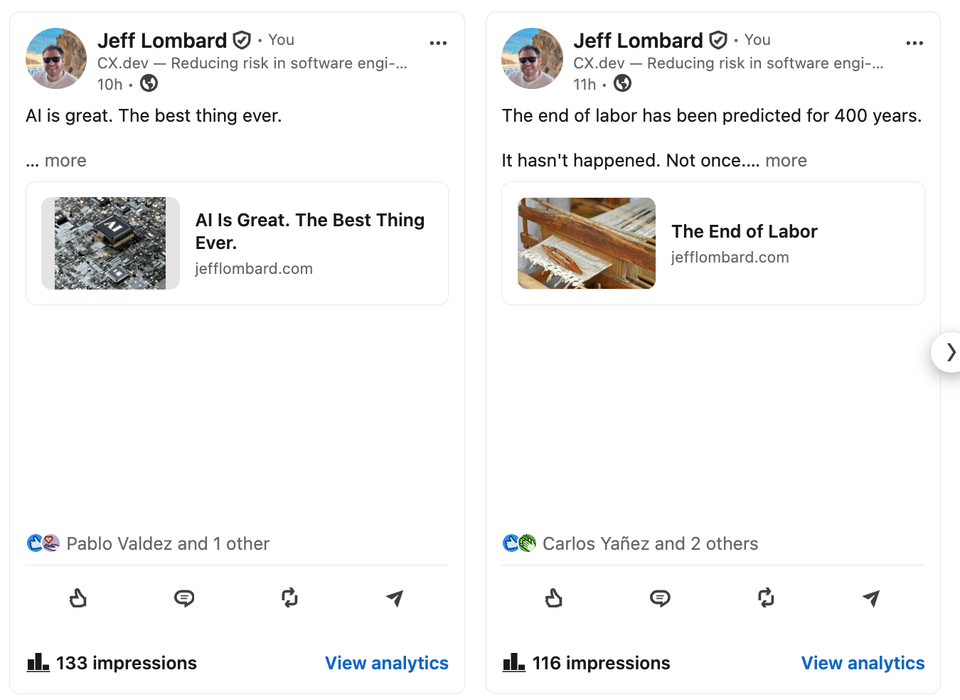
So I decided to run a tiny experiment.
I posted two articles to roughly the same audience, around the same time.
The first was titled:
“AI Is Great. The Best Thing Ever.”
The second:
“The End of Labor.”
The expectation was obvious.
Surely the AI post would dominate.
Surely the algorithm would reveal itself.
Surely LinkedIn’s secret AI favoritism machine would emerge from the shadows.
Instead?
The posts received almost identical impressions.
Not close-ish.
Actually close.
Which creates an uncomfortable possibility:
Maybe LinkedIn isn’t boosting AI content.
Maybe people just can’t stop clicking it.
And that possibility is far more interesting.
Humans are the algorithm
People love blaming platforms because it preserves the fantasy that we are rational participants trapped inside manipulated systems.
But most recommendation systems are mirrors before they are dictatorships.
If millions of people voluntarily click AI content:
- platforms surface more AI content
- creators make more AI content
- companies pivot toward AI content
- feeds become AI content
No conspiracy required.
Just incentives.
This is the same mistake people make with cable news.
They imagine executives in smoke-filled rooms deciding to destroy society for engagement metrics.
The darker truth is usually simpler:
the audience rewarded it.
The machine learned from us.
AI is the perfect engagement object
AI combines four extremely powerful psychological triggers:
1. Fear
People believe their jobs may disappear.
Fear is historically undefeated as an engagement strategy.
Especially white-collar fear.
Factory workers losing jobs was “economic transition.”
Knowledge workers losing jobs becomes an existential crisis.
When lawyers, marketers, consultants, designers, and engineers feel threatened, suddenly everyone develops a philosophical interest in automation.
2. Greed
Every technological gold rush creates a secondary economy of opportunists.
During the railroad boom:
everyone became a railroad expert.
During the dot-com bubble:
everyone became an internet strategist.
Now:
everyone is an AI advisor.
Entire consulting businesses are being built around translating:
“we pasted your PDF into ChatGPT”
into:
“enterprise transformation initiative.”
3. Status signaling
Posting about AI signals modernity.
It says:
- I understand the future
- I’m adaptable
- I’m technically aware
- I won’t be left behind
“AI-native” is rapidly becoming a class marker.
Not unlike “digitally transformed” in the 2010s.
Or “internet-savvy” in the late 90s.
Nobody wants to look obsolete in public.
Especially on LinkedIn, which is essentially a corporate peacock enclosure.
4. Hope
This is the overlooked one.
People are exhausted.
Burned out.
Overworked.
Drowning in meetings, dashboards, Slack notifications, Jira tickets, and corporate rituals nobody believes in anymore.
AI represents escape.
Maybe the machine will finally do the busywork.
Maybe productivity will increase.
Maybe we’ll work less.
Humanity has been telling itself this story for centuries.
Keynes predicted massive productivity gains would lead to abundant leisure time.
Instead, we invented email.
Then Slack.
Then “quick syncs.”
Then quarterly OKRs.
Now we use AI to answer messages generated by other AI systems inside meetings nobody wanted to attend.
Civilization is progressing beautifully.
Attention markets behave like financial markets
People talk about AI content as if it exists in a vacuum.
It doesn’t.
It exists inside an attention economy driven by speculation.
And speculative systems always produce bubbles.
Tulips.
Railroads.
Dot-coms.
Crypto.
NFTs.
Now AI.
This does not mean the underlying technology is fake.
Railroads mattered.
The internet mattered.
AI absolutely matters.
But transformative technologies and irrational social behavior frequently arrive together.
People confuse:
- “overhyped”
with - “not real”
These are not the same thing.
The dot-com bubble was irrational.
The internet still won.
LinkedIn is uniquely vulnerable to AI hysteria
Because LinkedIn is not really a social network.
It is a career survival network.
That distinction matters.
Twitter rewards entertainment.
Instagram rewards aesthetics.
TikTok rewards attention velocity.
LinkedIn rewards employability.
Which means every user is constantly managing perceived relevance.
So when AI appears as the dominant business narrative, people adapt immediately.
Not because they necessarily believe it.
Because they cannot afford not to participate.
This is why LinkedIn posts often feel vaguely cult-like.
Everyone speaks with bizarre certainty about technologies they barely understand because uncertainty performs poorly in professional signaling environments.
Nobody gets promoted for saying:
“There are still major unresolved implementation challenges.”
But:
“AI agents will reinvent enterprise workflows”
gets invited onto podcasts.
Corporate AI language already sounds religious
Watch how executives speak about AI internally.
“AI-powered.”
“AI-first.”
“AI transformation.”
“AI enablement.”
“AI acceleration.”
Half of it sounds less like engineering and more like incense rituals for shareholders.
The phrases are intentionally vague because vagueness is strategically useful.
Nobody wants to ask:
“What exactly does this do?”
Because that risks sounding obsolete.
So entire organizations drift into collective performance.
Consultants produce decks.
Executives repeat keywords.
Employees nod cautiously.
Boards approve budgets.
And somewhere underneath the theater, a handful of engineers quietly automate useful things while everyone else writes LinkedIn posts about “reimagining synergy through intelligent systems.”
The real danger isn’t AI
It’s optimization.
When every creator optimizes for engagement:
- language collapses into templates
- nuance disappears
- confidence outperforms accuracy
- everyone converges on the same topics
- feeds become indistinguishable
You can already see it happening.
Every post:
- “5 AI tools that changed my workflow”
- “AI won’t replace you, but people using AI will”
- “I spent 30 days using AI agents”
- “Hot take: AI is overhyped”
- “Unpopular opinion about AI”
Even anti-AI content becomes AI content.
The system absorbs all criticism and converts it into additional engagement inventory.
This is why blaming LinkedIn misses the point.
Platforms optimize around human behavior.
And humans are extraordinarily predictable under conditions of uncertainty and economic anxiety.
AI is real. The hysteria is real too.
This is the part people struggle to hold simultaneously.
AI is genuinely transformative.
It will reshape industries.
It will alter labor markets.
It will change software development, education, research, media, and operations.
But the social layer surrounding AI is also producing mass performative behavior.
People are not just reacting to technology.
They are reacting to:
- fear of falling behind
- pressure to appear informed
- economic insecurity
- status competition
- executive incentives
- investor expectations
In other words:
the same forces that shape every technological era.
Maybe the algorithm isn’t the story
The easiest explanation for AI content dominance is:
“LinkedIn is pushing it.”
The harder explanation is:
we are.
We click it.
We share it.
We reward it.
We build careers around it.
We panic about it.
We signal through it.
The platform may amplify the behavior.
But the behavior came first.
And honestly?
That’s much more revealing than a secret algorithm.
Because it means the feed is not merely showing us technology.
It’s showing us ourselves.